

Introduction :
When a vehicle breaks down, mechanics and scan tools use a specific language to describe the problem. Understanding automotive diagnostic terminology is the key to translating those technical reports into actionable steps. Whether you are plugging in an OBD2 scanner or talking to a service advisor, knowing these terms helps you avoid unnecessary repairs and keep your vehicle safe. This guide from Remliks Solutions breaks down the complex language of vehicle diagnostics into simple, clear English.
Disclaimer: This guide provides general information only. Always consult a qualified professional for specific diagnostic, repair, or safety advice. Follow USA safety standards (such as FMVSS and OSHA guidelines) when working on any vehicle.
Throughout this guide, you may see Bilal and Omar discussing vehicle systems, maintenance procedures, and troubleshooting situations. They are fictional educational characters created by Remliks Solutions to help explain automotive and truck concepts in a practical and engaging way.
1. Why Learning Automotive Diagnostic Terminology Matters
Vehicles today rely on dozens of computers and hundreds of sensors. When something goes wrong, these computers generate specific codes and data. If you do not understand the terminology, you cannot interpret the data.
Also, understanding these terms protects you from misdiagnosis. For example, a “lean code” does not mean your engine is broken; it means the engine is receiving too much air or too little fuel. Replacing random parts without understanding the terminology wastes money.
Before we explore the specific terms, let us look at how diagnostic language is organized.
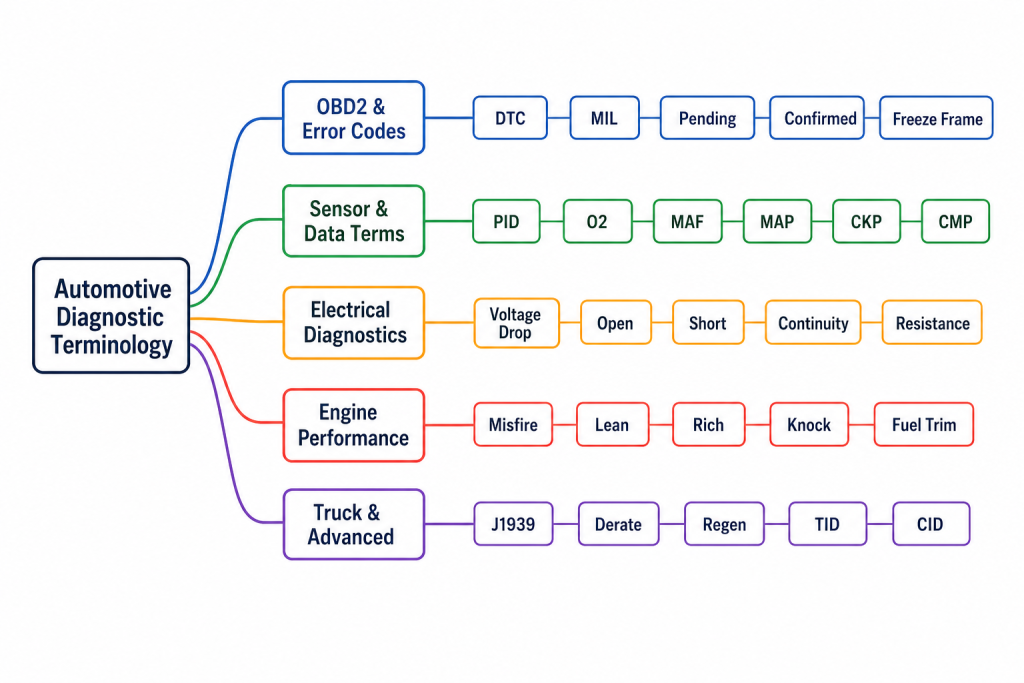
Mind Map: The Core Diagnostic Categories
To help you visualize how these terms connect, here is a simple text-based mind map of the primary diagnostic categories:
2. OBD2 & Error Code Terminology
The On-Board Diagnostics II (OBD2) system is the standardized language your vehicle uses to report emissions and engine problems. These terms form the foundation of automotive diagnostic terminology.
2.1 Understanding the Dashboard Lights
| Term | Simple Definition | Practical Importance |
|---|---|---|
| MIL | Malfunction Indicator Lamp (the Check Engine Light). | Illuminates when the ECU detects a fault that could affect emissions or engine operation. |
| DTC | Diagnostic Trouble Code. | An alphanumeric code (e.g., P0301) stored in the computer that identifies the specific system or component failing. |
| Pending Code | A code that has been detected once but not enough times to trigger the MIL. | Warns you of a potential problem before it becomes serious enough to turn on the check engine light. |
| Confirmed Code | A code that has been detected multiple times and triggers the MIL. | Indicates an active problem that requires diagnosis and repair. |
2.2 Data Capture Terms
- Freeze Frame: A snapshot of the engine data (like RPM, speed, and fuel trim) recorded at the exact moment a DTC was triggered. This helps mechanics see what conditions caused the failure.
- Key On Engine Off (KOEO): A testing state where the ignition is turned on, but the engine is not running. Used to check for hard faults in the electrical system.
- Key On Engine Running (KOER): A testing state where the engine is idling. Used to check sensors and actuators under operating conditions.
Omar and Bilal Workshop Scenario
Bilal: I scanned the car and found a Pending Code. Should I replace the part immediately?
Omar: No, a Pending Code means the computer noticed an issue once, but it has not confirmed it yet. Instead of replacing parts, we should look at the Freeze Frame data to see what the engine was doing when the code appeared. This may help us find the root cause without guessing.
3. Sensor & Data Terminology
Sensors act as the eyes and ears of the Engine Control Unit (ECU). When diagnosing a vehicle, you must understand the terms used to describe sensor data.
3.1 Parameter Identifications (PIDs)
| Term | Simple Definition | Practical Importance |
|---|---|---|
| PID | Parameter Identification. The specific data stream from a sensor. | Allows a scan tool to display live data, like engine temperature or RPM, in real-time. |
| TID | Test Identification. Identifies the specific monitor test the ECU is running. | Used mostly in advanced diagnostics to verify if an emissions monitor passed or failed. |
| CID | Component Identification. Identifies the exact cylinder or component being tested. | Useful when diagnosing cylinder-specific issues, like a misfire on cylinder number 3. |
3.2 Common Sensor Abbreviations in Diagnostics
When reading scan tool data, you will see these common sensor terms. Understanding what they measure is critical for accurate troubleshooting.
- MAF (Mass Air Flow): Measures the volume and density of air entering the engine. If the reading is too high or too low, the ECU will calculate the wrong fuel amount.
- MAP (Manifold Absolute Pressure): Measures the pressure inside the intake manifold. Used to calculate engine load.
- CKP (Crankshaft Position Sensor): Monitors the position and rotational speed of the crankshaft. Without this signal, the engine will not start because the ECU cannot time the spark or fuel.
- CMP (Camshaft Position Sensor): Monitors the rotation of the camshaft. Ensures the engine valves open at the correct time in relation to the pistons.
- O2 / HO2S (Oxygen Sensor / Heated Oxygen Sensor): Measures the amount of unburned oxygen in the exhaust. This data allows the ECU to adjust the air-fuel mixture in real-time.
4. Electrical Diagnostic Terminology
Electrical problems are among the most difficult to trace. This section of automotive diagnostic terminology describes the common electrical faults and measurements.
4.1 Circuit Fault Terms
| Term | Simple Definition | Practical Importance |
|---|---|---|
| Open Circuit | A break in the wiring or connector that stops electricity from flowing. | Like a broken bridge; the power cannot reach the component, so it stops working. |
| Short Circuit | Electricity takes an unintended shortcut to ground or another wire. | Can cause fuses to blow, wires to melt, or components to stay on when they should be off. |
| High Resistance | A partial blockage in the circuit, usually caused by rust or loose connections. | Reduces voltage to the component, causing dim lights, slow motors, or strange sensor readings. |
4.2 Diagnostic Measurement Terms
- Continuity: A test to check if an electrical circuit is complete (has no opens). A multimeter beeps if continuity exists.
- Voltage Drop: The amount of electrical pressure lost across a connection or wire. A high voltage drop indicates high resistance. Testing voltage drop is far more accurate than just checking if power is present.
- Parasitic Draw: An electrical drain that continues after the vehicle is turned off. A small draw is normal (for radio memory and ECU keep-alive memory), but a large draw will kill the battery overnight.
Omar and Bilal Workshop Scenario
Bilal: The headlights are very dim. The battery voltage reads 12.6 volts, so the battery is good. What is the problem?
Omar: A battery test only tells us the source voltage. We must perform a voltage drop test on the headlight circuit. If there is high resistance in the ground wire or the switch, the headlights will not receive full voltage. Therefore, they will glow dimly even with a good battery.
5. Engine Performance Terminology
When a vehicle runs poorly, mechanics use specific words to describe how the engine is failing. Understanding these terms helps you describe symptoms accurately.
5.1 Air and Fuel Mixture Terms
| Term | Simple Definition | Practical Importance |
|---|---|---|
| Lean Mixture | The engine has too much air and not enough fuel. | May cause hesitation, high engine temperatures, and trigger lean DTCs (like P0171). |
| Rich Mixture | The engine has too much fuel and not enough air. | May cause poor fuel economy, black smoke from the exhaust, and trigger rich DTCs (like P0172). |
| Fuel Trim | The adjustment the ECU makes to the fuel injection time to maintain the correct air-fuel ratio. | Positive fuel trim means the ECU is adding fuel (compensating for a lean condition). Negative means it is removing fuel (compensating for a rich condition). |
5.2 Combustion and Ignition Terms
- Misfire: When the air-fuel mixture in a cylinder fails to ignite at the correct time, or fails to ignite at all. This causes a loss of power and can damage the catalytic converter over time.
- Knock (Detonation): Uncontrolled, explosive combustion in the cylinder that happens after the spark. It sounds like a rattling marble and can crack pistons.
- Pre-ignition: The air-fuel mixture ignites before the spark plug fires, usually caused by a hot spot in the cylinder. This is highly destructive.
- Backfire: An explosion that occurs in the intake or exhaust system, rather than inside the combustion chamber. Often caused by severe timing or mixture issues.
6. Advanced & Truck Diagnostic Terminology
Heavy-duty trucks and advanced vehicles use specialized diagnostic protocols. If you work on diesel trucks, this automotive diagnostic terminology is essential. (Visit our Truck Systems section for more).
6.1 Heavy-Duty Protocols
- J1939: The communication standard used by heavy-duty commercial vehicles (like semi-trucks). It is the truck equivalent of the OBD2 standard for passenger cars.
- MID (Message Identifier): Used in J1939 systems to identify which electronic control module is sending the data.
- SID (Subsystem Identifier): Identifies the specific subsystem (like a specific fuel injector) within the module that is reporting the fault.
6.2 Diesel Emissions Diagnostics
| Term | Simple Definition | Practical Importance |
|---|---|---|
| Derate | The engine computer intentionally limits engine power and speed. | A protective measure. If the ECU detects a severe emissions fault (like low DEF), it derates the engine to force a repair. |
| Regen (Regeneration) | The process of burning off trapped soot in the Diesel Particulate Filter (DPF). | A parked regen is manually started. A driving regen happens automatically. Failed regens cause clogged DPFs and derates. |
| DOC (Diesel Oxidation Catalyst) | A catalyst that converts carbon monoxide and hydrocarbons into carbon dioxide and water. | Works with the DPF to clean diesel exhaust. |
7. Visual Overview: How Diagnostic Terms Connect to Remliks Solutions
Below is a Flexbox-style table that connects the diagnostic terminology to the core sections of the Remliks Solutions website. Use this to navigate your learning path and find practical troubleshooting steps.
| Remliks Learning Center Section | Key Diagnostic Terms Covered |
|---|---|
| Diagnostic & Scan Tools | OBD2, DTC, PID, Freeze Frame, KOEO, KOER |
| Warning Lights & Error Codes | MIL, Pending Code, Confirmed Code, Derate |
| Engine System | Misfire, Lean, Rich, Fuel Trim, Knock, MAF, MAP |
| Electrical System | Open Circuit, Short Circuit, Voltage Drop, Parasitic Draw, Continuity |
| Truck Systems | J1939, SID, MID, Regen, DOC, DPF, Derate |
| Troubleshooting Center | Applying all terms to real-world step-by-step diagnosis |
8. Checklist: Using Automotive Diagnostic Terminology Effectively
Use this simple checklist to apply your diagnostic knowledge safely and accurately:
- [ ] Read the Code Carefully: Do not just read the DTC number; read the code definition. A P0171 means “System Too Lean,” not “Replace Oxygen Sensor.”
- [ ] Check Freeze Frame Data: Always look at the engine conditions when the code happened. This gives you the context of the failure.
- [ ] Test, Do Not Guess: Use terms like “Voltage Drop” and “Continuity” to test circuits before replacing parts.
- [ ] Understand Fuel Trim: Use fuel trim data to see if the engine is running lean or rich before throwing parts at a rough idle.
- [ ] Respect Derates: If a truck enters a derate, understand it is a protective mode. Fix the underlying emissions fault first.
- [ ] Consult Professionals: Electrical diagnostics and emissions faults can be complex. Seek a certified technician if you are unsure.
9. FAQ: Automotive Diagnostic Terminology
9.1 What is the difference between a Pending Code and a Confirmed Code?
A Pending Code means the ECU noticed a potential problem once, but it needs to see the problem happen again on the next trip to confirm it. A Confirmed Code means the problem has occurred enough times to trigger the Malfunction Indicator Lamp (Check Engine Light). Pending codes help you catch issues early.
9.2 What does “Fuel Trim” actually mean?
Fuel Trim is the ECU’s way of adjusting fuel delivery. If the engine is running lean (too much air), the ECU adds fuel (Positive Fuel Trim). If the engine is running rich (too much fuel), the ECU takes fuel away (Negative Fuel Trim). High fuel trim numbers often indicate a vacuum leak, bad sensor, or fuel delivery problem.
9.3 Is a Voltage Drop the same as low battery voltage?
No, they are very different. Low battery voltage means the power source is weak. A Voltage Drop means there is high resistance (like rust or a loose connection) in the wiring between the battery and the component. Even with a fully charged battery, a bad ground wire can cause a voltage drop, leaving the component without enough power to work properly.
9.4 Why do mechanics test for Continuity?
Mechanics test for Continuity to find Open Circuits. If a wire is broken inside the insulation, electricity cannot flow. A multimeter set to continuity beeps if the wire is whole and complete. If it does not beep, the mechanic knows exactly where the circuit is broken.
9.5 What does it mean when a diesel truck goes into Derate?
A Derate means the truck’s computer has limited the engine’s power and top speed. This happens when a severe emissions-related problem is detected, such as low DEF fluid, a failing NOx sensor, or a completely clogged DPF. The computer limits power to protect the engine and force the driver to repair the emissions system.
10. Conclusion: Empowering Your Diagnostic Journey
Deciphering automotive diagnostic terminology transforms you from a passive vehicle owner into an informed problem-solver. When you understand the difference between an Open Circuit and a Short Circuit, or know what Fuel Trim is telling you, you take control of the repair process.
Also, we encourage you to explore our Troubleshooting Center, check our Warning Lights & Error Codes library, or read our Diagnostic & Scan Tools guides, think methodically, and keep learning with Remliks Solutions.