

Disclaimer: This article provides general information only. It is for educational purposes and does not replace professional mechanical advice or service manuals. Always follow safety guidelines and manufacturer instructions when working on vehicles.
Have you ever lifted the hood of your car and felt overwhelmed by the maze of wires, hoses, and metal parts? You are not alone. However, understanding vehicle systems is not as complicated as it looks. A car is simply a collection of interconnected systems, each with a specific job. When you break it down, each system is logical and fascinating.
At Remliks solutions , we believe that knowledge is power. When you understand your vehicle, you can take better care of it, communicate clearly with mechanics, and drive with more confidence. This guide will walk you through the main systems of a vehicle in simple, clear language.
We will explore the engine, transmission, brakes, steering, suspension, and electrical systems. We will also explain how they work together to keep you safe on the road. Let’s start by looking at the big picture of how these systems function as a team.
The Big Picture: How Vehicle Systems Work Together
A vehicle is like a human body. It has a heart (engine), muscles (transmission), a skeleton (frame), and a nervous system (electrical). Just as the human body relies on organs working together, a car relies on its systems to function. If one system fails, it often affects the others.
To visualize this, imagine the flow of energy and information:
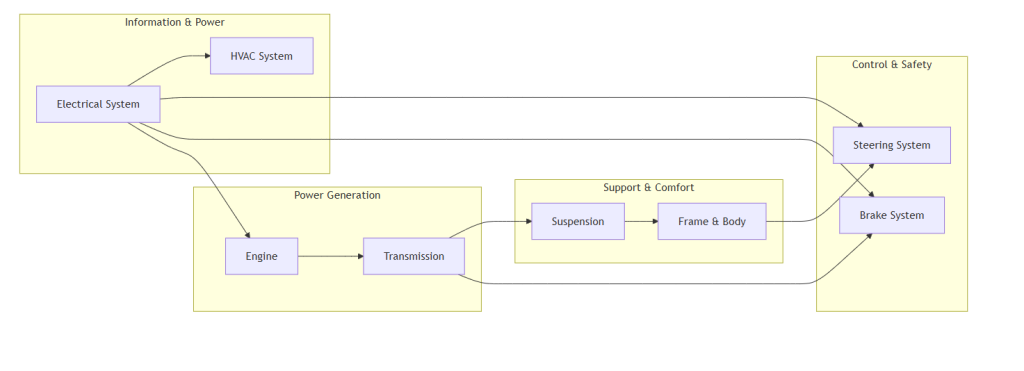
As the diagram shows, the electrical system acts as the nervous system, powering and connecting everything. The engine generates power, which the transmission manages. The brakes and steering give you control, while the suspension and frame provide stability.
Now, let’s dive into each system to understand its role, key parts, and basic maintenance needs.
1. The Engine System: The Heart of Power
The engine is the power source. Its job is turn fuel into motion. Most cars use an internal combustion engine. This means it burns fuel inside cylinders to create small explosions. These explosions push pistons, which turn a crankshaft, creating the spinning power needed to move the car.
Key Engine Subsystems
The engine is made up of several smaller systems that support it:
- Fuel System: Delivers fuel to the engine. It includes the fuel tank, pump, filter, and injectors. The pump sends fuel to the engine, and the injectors spray it in a fine mist for efficient burning.
- Air Intake System: Brings air in for combustion. Air mixes with fuel to burn. The air filter removes dust and dirt. A clean air filter is vital for performance.
- Ignition System (Gasoline): Creates the spark to ignite the fuel. It includes spark plugs and ignition coils. The coil turns battery power into a high-voltage spark.
- Cooling System: Keeps the engine from getting too hot. It uses coolant (antifreeze) to absorb heat. A water pump moves the coolant through the engine and to the radiator, where air cools it down.
- Lubrication System: Reduces friction between moving metal parts. The oil pump circulates oil through the engine. Oil coats the parts, so they do not grind against each other.
- Exhaust System: Removes burnt gases. It includes the exhaust manifold, catalytic converter, and muffler. The converter reduces harmful pollution, and the muffler quiets the noise.
Diesel vs. Gasoline Engines
The main difference is how they burn fuel:
- Gasoline Engines: Use a spark plug to ignite a mix of air and fuel.
- Diesel Engines: Do not use spark plugs. They compress air until it is very hot. Then, diesel fuel is injected into the hot air, causing it to ignite on its own.
Engine Maintenance Tips
💡 Safety Tip: Never open the radiator cap when the engine is hot. The hot coolant is under pressure and can spray out and burn you.
- Check Oil Monthly: Pull the dipstick, wipe it, reinsert it, and check the level. Low oil can destroy an engine.
- Change Oil Regularly: Follow your owner’s manual. This removes dirt and keeps the engine protected.
- Inspect Coolant: Check the level in the overflow tank when the engine is cool.
- Replace Air Filter: A clogged filter reduces fuel economy. Change it every 15,000 to 30,000 miles.
2. The Transmission System: Managing Power
The transmission works with the engine. It takes the power from the engine and delivers it to the wheels. Think of it like the gears on a bicycle. It allows the engine to run efficiently while the car travels at different speeds.
What Does a Transmission Do?
- Torque Multiplication: Gives the car power to start moving from a stop and climb hills.
- Speed Reduction: Allows the car to cruise at high speeds without the engine working too hard.
- Reverse: Allows the car to move backward.
- Neutral: Disconnects the engine from the wheels.
Types of Transmissions
- Manual Transmission (MT): The driver uses a clutch pedal and gear stick to change gears manually.
- Automatic Transmission (AT): The car changes gears for you automatically using a fluid coupling called a torque converter.
- Continuously Variable Transmission (CVT): Uses a belt and pulleys to provide an infinite number of gear ratios. It is very smooth and efficient.
- Dual-Clutch Transmission (DCT): Uses two clutches for very fast, automatic shifts. It is often found in sporty cars.
Key Drivetrain Components
The transmission is part of the drivetrain. Other parts include:
- Clutch (Manual Only): Connects and disconnects the engine from the transmission.
- Drive Shafts: Long metal tubes that carry power to the wheels.
- Differential: Allows the wheels to spin at different speeds when turning. This is necessary because the outside wheel travels farther than the inside wheel.
Transmission Maintenance Tips
⚠️ Warning: Never shift from “Park” to “Drive” or “Reverse” while the car is still rolling. This can damage the transmission.
- Check Fluid (Some Automatics): Low or dirty fluid can cause shifting problems. Check your manual; many modern cars have sealed units.
- Change Fluid When Needed: Fresh fluid ensures smooth shifting and long life.
- Use the Parking Brake: On hills, use the parking brake before shifting into “Park.” This reduces stress on the transmission.
3. The Brake System: Ensuring Safety
The brake system is your most important safety feature. It converts the car’s movement energy into heat energy to slow it down. Most cars use hydraulic brakes, meaning they use fluid to transfer force from your foot to the wheels.
How Brakes Work
When you press the brake pedal, you push fluid through lines to the wheels. This fluid pressure activates brake components that create friction.
- Disc Brakes: Most common on the front. A caliper squeezes brake pads against a spinning rotor (disc).
- Drum Brakes: Often on the rear. Brake shoes push outward against the inside of a spinning drum.
Key Components and ABS
- Master Cylinder: Creates the hydraulic pressure.
- Brake Lines & Hoses: Carry the fluid.
- Calipers & Wheel Cylinders: Push the pads or shoes.
- Brake Pads & Shoes: The friction material that wears out over time.
- ABS (Anti-lock Braking System): Prevents wheels from locking up during hard braking, allowing you to steer while braking. If you feel the pedal pulse, don’t let up – that’s the ABS working.
Brake Maintenance Tips
🔧 Listen to Your Car: Squealing or grinding noises usually mean the brake pads are worn and need replacement.
- Inspect Pads Regularly: Have a mechanic look at them at least once a year or during tire rotations.
- Check Fluid: Low fluid may indicate a leak or worn pads.
- Flush Fluid: Change brake fluid every 2-3 years to prevent internal corrosion and maintain performance.
4. The Steering System: Control at Your Fingertips
The steering system allows you to guide the car. It turns the rotation of the steering wheel into the movement of the front wheels.
How It Works
- Steering Column: Connects the wheel to the steering gear.
- Steering Gear: Multiplies your effort. The most common type is Rack and Pinion. A small gear (pinion) on the steering shaft moves a toothed bar (rack) side to side.
- Steering Linkage: Tie rods connect the rack to the wheels, turning them left or right.
Power Steering
Power steering makes turning easy, especially at low speeds.
- Hydraulic Power Steering: Uses a pump driven by the engine to provide assistance.
- Electric Power Steering (EPS): Uses an electric motor. It is more efficient and is becoming the standard.
Steering Maintenance Tips
- Check Fluid (Hydraulic): Ensure the power steering fluid is at the correct level and is clean (not black or burnt).
- Watch for Leaks: Look for puddles under the car.
- Notice Changes: If the steering feels loose, vibrates, or is hard to turn, have it inspected.
5. The Suspension System: The Ride and Handlers
The suspension system connects the car’s body to the wheels. It does three main jobs: supports the car’s weight, absorbs bumps for a smooth ride, and keeps the tires firmly on the road for good handling.
Key Components
- Springs: Support the weight and absorb large bumps.
- Shock Absorbers / Struts: Dampen the up-and-down motion of the springs. They stop the car from bouncing endlessly after hitting a bump.
- Control Arms: Hold the wheels in place and allow them to move up and down.
- Sway Bars: Reduce body roll (leaning) when cornering.
Suspension Maintenance Tips
💡 Test Your Shocks: Push down firmly on a corner of the car and release. It should bounce no more than once or twice before settling. If it keeps bouncing, the shocks may be worn.
- Inspect for Leaks: Look for oil leaking from the shock absorbers.
- Check Alignment: If the car pulls to one side or tires wear unevenly, the alignment may be off.
- Rotate Tires: This promotes even wear, which helps suspension performance.
6. The Electrical System: The Nervous System
The electrical system provides the power to start the car and run all the electronics, from lights to the engine computer.
Main Components
- Battery: Stores 12-volt electricity to start the engine and power accessories when the engine is off.
- Alternator: Driven by the engine, it generates electricity to recharge the battery and power the car’s systems while driving.
- Starter Motor: Uses battery power to crank (turn) the engine to start it.
- Wiring & Fuses: A network of wires carries electricity. Fuses protect the system from overloads and electrical fires.
- ECUs (Computers): Modern cars have many computers. The Engine Control Module (ECM) manages the engine, while others control the transmission, brakes, and more. They communicate over networks like CAN bus.
Electrical Maintenance Tips
- Clean Battery Terminals: Corrosion (white powder) can prevent the car from starting. Clean it with a mix of baking soda and water.
- Test Battery Health: Batteries usually last 3-5 years. Have it tested before it fails.
- Watch for Warning Lights: The “Battery” or “Alt” light often means the alternator is not charging properly, not necessarily a battery problem.
7. The HVAC System: Comfort Inside
HVAC stands for Heating, Ventilation, and Air Conditioning. It keeps the cabin comfortable and the windows clear.
How It Works
- Heating: Uses hot coolant from the engine. A small radiator called a heater core inside the dashboard provides the heat.
- Air Conditioning: Uses a refrigerant to remove heat and moisture from the cabin air. A compressor pumps the refrigerant through a system of coils to cool the air.
- Ventilation: The blower motor pushes air through the heater core, AC evaporator, or ducts.
HVAC Maintenance Tips
- Replace Cabin Air Filter: This filter cleans the air entering the cabin. A dirty filter reduces airflow and AC efficiency. Replace it every year or 12,000-15,000 miles.
- Run AC Weekly: Run the AC for a few minutes in winter to keep the system lubricated and prevent mold growth.
8. The Body and Frame: The Protective Shell
The body provides a place for passengers and cargo. The frame is the strong structure that holds everything together.
- Body-on-Frame: A separate steel frame holds the engine and suspension, and the body sits on top. Common on trucks.
- Unibody: The frame and body are one welded unit. Lighter and more common on cars.
Maintenance Tips
- Wash and Wax: Protects the paint and metal from rust.
- Rust Proofing: In salty climates, apply protection to the undercarriage.
- Inspect for Damage: Fix dents and scratches early to prevent rust.
Checklist: Monthly Vehicle Health Check
Use this simple list to keep your car running well.
| System | Task | Frequency |
|---|---|---|
| General | Walk-around visual inspection for leaks or damage. | Monthly |
| Engine | Check oil level with the dipstick. | Monthly |
| Cooling | Check coolant level in the overflow tank (when cold). | Monthly |
| Electrical | Check battery terminals for corrosion. | Monthly |
| Tires | Check tire pressure and look for damage. | Monthly |
| Brakes | Listen for squealing or grinding noises. | Ongoing |
FAQ: Common Questions About Vehicle Systems
1. What is the most important system in my car?
While all are critical, the brake system is most vital for immediate safety. However, the engine is essential for movement, and the electrical system powers everything.
2. How do I know if my battery or alternator is failing?
If the car is slow to start or won’t start, it is often the battery. If the car dies while driving or headlights dim significantly, it is likely the alternator failing.
3. Why does my car pull to one side?
This can be caused by uneven tire pressure, misaligned wheels, or a stuck brake caliper. It is best to have a mechanic diagnose it.
4. Can I mix synthetic and conventional oil?
Yes, you can mix them. However, it is generally best to stick to the type recommended in your owner’s manual once you choose one.
5. What does the “Check Engine” light mean?
It means the engine computer has detected a problem. It could be minor (loose gas cap) or serious (engine misfire). You should have the code read by a professional.
6. How often should I change my oil?
It depends on the oil type and your car. Check your owner’s manual. Modern cars using synthetic oil can often go 7,500 to 10,000 miles between changes.
Conclusion: Empowering Yourself Through Knowledge
Understanding vehicle systems turns a mysterious machine into a logical collection of parts. By learning the basics of the engine, transmission, brakes, and other systems, you become a more responsible car owner.
This knowledge helps you:
- Perform basic maintenance to save money and prevent problems.
- Describe issues accurately to a mechanic, saving time and money.
- Drive with confidence, knowing you can spot warning signs.
At Remliks solutions , we are here to guide you on your journey to automotive literacy. This guide is just the beginning. We encourage you to explore our other articles for more detailed information on specific systems. Always remember to consult your owner’s manual and seek professional help for complex repairs. Safe travels