

Understanding your vehicle starts with understanding the language used to describe it. Whether you are reading a diagnostic report, talking to a mechanic, or browsing our Learning Center, knowing essential automotive terms A-Z gives you the confidence to make informed decisions. This comprehensive glossary by Remliks Solutions breaks down complex vehicle systems, diagnostics, and maintenance concepts into simple, clear English.
Disclaimer: This guide provides general information only. Always consult a qualified professional for specific diagnostic, repair, or safety advice. Follow USA safety standards (such as FMVSS and OSHA guidelines) when working on any vehicle.
Throughout this guide, you may see Bilal and Omar discussing vehicle systems, maintenance procedures, and troubleshooting situations. They are fictional educational characters created by Remliks Solutions to help explain automotive and truck concepts in a practical and engaging way.
1. Why Learning Automotive Terms A-Z Matters
Vehicles are complex machines with thousands of parts. When a dashboard warning light turns on, or a mechanic mentions a failing component, understanding the basic terminology can save you time, money, and stress.
Also, when you know the correct terms, you can:
- Communicate clearly with technicians.
- Diagnose simple problems safely.
- Purchase the correct tools and parts.
- Maintain your vehicle according to the manufacturer’s schedule.
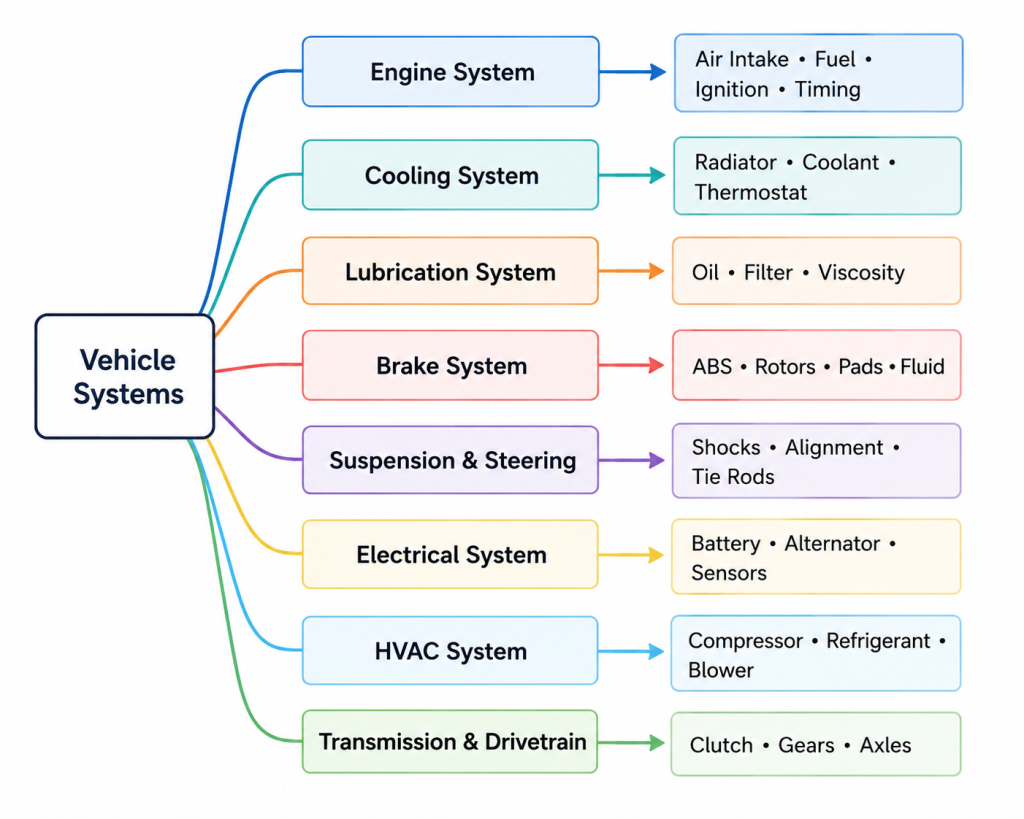
Before we dive into the alphabetical list, let us look at how these terms connect to the major systems in your vehicle.
Mind Map: The Core Vehicle Systems
To help you visualize how these terms relate to each other, here is a simple text-based mind map of the primary vehicle categories:
Vehicle Systems:
2. Automotive Terms A-B: Engine & Vehicle Systems Fundamentals
Let us begin our automotive terms A-Z journey with the foundational components that make a vehicle start and move.
2.1 A – Air, Alignment, and ABS
| Term | Simple Definition | Vehicle System | Practical Importance |
|---|---|---|---|
| ABS (Anti-lock Braking System) | A safety system that prevents wheels from locking during hard braking. | Brake System | Helps the driver maintain steering control on slippery roads. Meets USA FMVSS standards. |
| Air-Fuel Ratio (AFR) | The ratio of air to fuel entering the engine cylinders. | Engine System | A correct AFR ensures efficient combustion and prevents engine damage. |
| Alignment | Adjusting the angles of the wheels so they are perpendicular to the ground and parallel to each other. | Suspension & Steering | Prevents uneven tire wear and ensures the vehicle drives straight. |
Omar and Bilal Workshop Scenario
Bilal: The brake pedal vibrates a lot when I stop quickly on wet roads. Is the brake system failing?
Omar: Not necessarily. If your vehicle has ABS, a vibrating pedal is a normal function. The system rapidly pulses the brakes to prevent the wheels from locking up. However, if the vibration happens during normal, dry braking, the brake rotors may be warped. We should inspect them to be sure.
2.2 B – Bearings, Boost, and Brake Fade
- Bearing: A component that reduces friction between moving parts (like wheel bearings allowing the wheel to spin freely on the axle).
- Boost: The increase in pressure delivered by a turbocharger or supercharger into the engine’s intake.
- Brake Fade: The temporary loss of braking power caused by excessive heat building up in the brake components.
How Boost Works (Forced Induction):
When an engine needs more power, it needs more air. A turbocharger uses exhaust gases to spin a turbine. This turbine forces extra air (boost) into the engine. More air means the engine can burn more fuel, which may help increase power output. However, it also increases engine temperatures, requiring proper cooling and lubrication.
3. Automotive Terms C-D: Cooling, Drivetrain & Diagnostics
3.1 C – Coolant, Compression, and Catalytic Converters
| Term | Simple Definition | Vehicle System | Practical Importance |
|---|---|---|---|
| Catalytic Converter | An emissions control device that changes toxic gases into less harmful emissions. | Engine/Exhaust | Required by USA law; a failing converter triggers a Check Engine Light. |
| Coolant | A liquid mixture (usually water and antifreeze) that absorbs engine heat. | Cooling System | Prevents the engine from overheating in summer or freezing in winter. |
| Compression | The process of squeezing the air-fuel mixture inside the engine cylinder before ignition. | Engine System | Low compression may cause poor engine performance or starting issues. |
3.2 D – Differentials, DTCs, and Drivetrain
- Differential: A set of gears that allows the left and right wheels to rotate at different speeds, especially when turning a corner.
- DTC (Diagnostic Trouble Code): An alphanumeric code stored by the vehicle’s computer when it detects a fault. (Learn more in our Warning Lights & Error Codes section).
- Drivetrain: The collection of components that deliver power from the engine to the wheels (transmission, driveshaft, differential, axles).
4. Automotive Terms E-F: Electrical System & Fuel Components
4.1 E – ECU, EGR, and Exhaust
| Term | Simple Definition | Vehicle System | Practical Importance |
|---|---|---|---|
| ECU (Engine Control Unit) | The vehicle’s main computer that manages engine performance and emissions. | Electrical System | Uses sensor data to adjust fuel, ignition, and emissions systems. |
| EGR (Exhaust Gas Recirculation) | A system that reroutes a small amount of exhaust gas back into the intake to lower combustion temperatures. | Engine System | Reduces harmful nitrogen oxide (NOx) emissions. |
| Exhaust Manifold | A pipe that collects exhaust gases from multiple cylinders and delivers them to the exhaust pipe. | Engine/Exhaust | Cracks can cause loud engine noise and exhaust leaks. |
4.2 F – Fuel Injectors, Fuses, and Four-Wheel Drive
- Fuel Injector: An electronically controlled valve that sprays the exact amount of fuel into the engine cylinder or intake manifold.
- Fuse: A safety device that breaks an electrical circuit if the current gets too high, preventing fires and wire damage.
- Four-Wheel Drive (4WD): A drivetrain system that sends power to all four wheels simultaneously, usually used for off-road or slippery conditions.
5. Automotive Terms G-H: Gears, Heating & HVAC
5.1 G – Gaskets and Gear Ratios
- Gasket: A seal that fills the space between two engine parts to prevent leaks (like a head gasket between the engine block and cylinder head).
- Gear Ratio: The relationship between the number of teeth on two meshing gears. It determines how much torque (turning force) is delivered to the wheels versus how fast the wheels spin.
5.2 H – Horsepower, HVAC, and Head Gasket
| Term | Simple Definition | Vehicle System | Practical Importance |
|---|---|---|---|
| Horsepower (HP) | A unit of measurement for the engine’s power output. | Engine System | Helps compare the power capabilities of different vehicles. |
| HVAC | Heating, Ventilation, and Air Conditioning. | HVAC System | Controls cabin temperature and air quality for passenger comfort. |
| Head Gasket | A critical seal between the engine block and the cylinder head. | Engine/Cooling | A blown head gasket may allow coolant to mix with engine oil, causing severe engine damage. |
6. Automotive Terms I-J-K: Ignition, Joints & Key Components
6.1 I – Ignition and Intake
- Ignition Coil: A transformer that changes low voltage from the battery into the high voltage needed to create a spark at the spark plug.
- Intake Manifold: A series of tubes that delivers the air-fuel mixture to the engine cylinders.
6.2 J & K – Jounce and Knock Sensors
- Jounce: The upward movement of the suspension when the wheel hits a bump (also called compression).
- Knock Sensor: A sensor that listens for engine “knocking” or pinging (uncontrolled combustion) and signals the ECU to adjust ignition timing to prevent damage.
Omar and Bilal Workshop Scenario
Bilal: I hear a rattling sound from the engine when I accelerate uphill. Is that normal?
Omar: That sound is often called “knocking” or “pinging.” It happens when the air-fuel mixture ignites too early or unevenly. The knock sensor should detect this and tell the ECU to adjust the timing. If the sound continues, the sensor may be failing, or the fuel grade may be incorrect. We should scan the system for a DTC.
7. Automotive Terms L-M: Lubrication & Maintenance Terms
7.1 L – Lubrication and Lug Nuts
- Lubrication System: The system that supplies oil to all moving engine parts to reduce friction, wear, and heat. (Visit our Lubrication System section for more).
- Lug Nut: A large nut that secures the wheel to the vehicle’s wheel studs.
7.2 M – MAP Sensor, Misfire, and Maintenance
| Term | Simple Definition | Vehicle System | Practical Importance |
|---|---|---|---|
| MAP Sensor | Manifold Absolute Pressure sensor; measures the air pressure inside the intake manifold. | Engine/Electrical | Helps the ECU calculate the correct air-fuel mixture. |
| Misfire | When the air-fuel mixture inside a cylinder fails to ignite at the correct time. | Engine/Ignition | Causes rough idling, loss of power, and increased emissions. |
| Maintenance | Routine care (like oil changes and filter replacements) performed to keep the vehicle in working order. | All Systems | Prevents costly breakdowns and extends vehicle life. |
8. Automotive Terms N-O: Noise Diagnosis & OBD2 Systems
8.1 N – NVH and NOx
- NVH (Noise, Vibration, Harshness): The study of how a vehicle sounds and feels. Diagnosing NVH issues helps identify failing bearings, unbalanced tires, or exhaust leaks.
- NOx (Nitrogen Oxides): Harmful pollutants produced when engine combustion temperatures are too high. The EGR system helps reduce them.
8.2 O – OBD2 and Octane
- OBD2 (On-Board Diagnostics II): The standardized system in all USA vehicles built after 1996 that monitors engine and emissions systems. (Explore our Diagnostic & Scan Tools section for scanners).
- Octane Rating: A measure of a fuel’s ability to resist knocking. Higher octane fuel does not necessarily mean more power; it simply resists premature ignition in high-compression engines.
9. Automotive Terms P-Q: Powertrain & Quick Reference Terms
9.1 P – PCV Valve, PSI, and Powertrain
- PCV Valve (Positive Crankcase Ventilation): A valve that recycles unburned gases from the engine crankcase back into the intake manifold to be burned again.
- PSI (Pounds per Square Inch): A unit of pressure. Used to measure tire pressure and fuel pressure.
- Powertrain: The entire system that generates power and delivers it to the road (Engine + Transmission + Drivetrain).
9.2 Q – Quick Disconnect
- Quick Disconnect: A type of fitting used in fuel and AC lines that allows for fast removal without specialized tools. However, caution is required as fuel systems hold pressure even when the engine is off.
10. Automotive Terms R-S: Radiators, Suspension & Steering
10.1 R – Radiator, Rotor, and Refrigerant
| Term | Simple Definition | Vehicle System | Practical Importance |
|---|---|---|---|
| Radiator | A heat exchanger that cools the engine coolant as air flows through its fins. | Cooling System | A leaking or clogged radiator may cause the engine to overheat. |
| Rotor (Brake Disc) | The flat, round metal disc that the brake pads press against to stop the wheel. | Brake System | Warped rotors cause steering wheel vibration during braking. |
| Refrigerant | The chemical fluid used in the AC system to absorb and release heat, cooling the cabin. | HVAC System | Must be handled carefully according to EPA regulations. |
10.2 S – Spark Plug, Steering Rack, and Suspension
- Spark Plug: An electrical device that creates a spark to ignite the air-fuel mixture inside the engine cylinder.
- Steering Rack: A component that converts the rotational motion of the steering wheel into the linear motion needed to turn the wheels.
- Suspension: The system of springs, shock absorbers, and linkages that connects a vehicle to its wheels, supporting the vehicle’s weight and absorbing road bumps.
11. Automotive Terms T-U: Transmission & Underhood Systems
11.1 T – Thermostat, Torque, and Transmission
- Thermostat: A temperature-controlled valve in the cooling system that regulates coolant flow to keep the engine at its optimal operating temperature.
- Torque: A measure of the rotating force the engine produces. High torque is especially important for trucks to haul heavy loads.
- Transmission: The gearbox that adapts the engine’s output to the drive wheels, allowing the vehicle to move at different speeds. (See our Transmission & Drivetrain section).
11.2 U – U-Joint and Understeer
- U-Joint (Universal Joint): A flexible coupling on the driveshaft that allows it to rotate while changing angles as the suspension moves. Common in truck systems.
- Understeer: A handling condition where the vehicle turns less sharply than the driver intends, typically in front-wheel-drive cars on slippery surfaces.
12. Automotive Terms V-W: Vehicle Dynamics & Warning Lights
12.1 V – Viscosity, Voltage, and VTEC
- Viscosity: The thickness or resistance to flow of a liquid. For example, 10W-30 motor oil has a specific viscosity that changes with temperature.
- Voltage: Electrical pressure from the battery or alternator. A healthy car battery should read around 12.6 volts when the engine is off.
- VTEC (Variable Valve Timing and Lift Electronic Control): A specific Honda system that adjusts valve timing for better efficiency at low RPMs and more power at high RPMs.
12.2 W – Warning Lights and Wheel Speed Sensor
- Warning Lights: Dashboard indicators that alert the driver to a system problem. Common examples include the Check Engine Light, Oil Pressure Light, and ABS Light. (Look up specific codes in our Warning Lights & Error Codes section).
- Wheel Speed Sensor: A sensor at each wheel that monitors how fast the wheel is rotating. Critical data for the ABS and traction control systems.
13. Automotive Terms X-Y-Z: X-Axis, Yields & Zero Emissions
13.1 X & Y – X-Frame and Yaw Sensor
- X-Frame: A specific type of vehicle chassis frame shaped like an X, historically used in some older full-size cars.
- Yaw Sensor: A device that measures the vehicle’s rotation around its vertical axis (slipping or sliding sideways). This data is crucial for Electronic Stability Control (ESC).
13.2 Z – Zerk Fitting and Zero Emissions
| Term | Simple Definition | Vehicle System | Practical Importance |
|---|---|---|---|
| Zerk Fitting | A small metal fitting used to inject grease into suspension or steering components. | Suspension/Steering | Allows for easy lubrication of moving parts during routine maintenance. |
| Zero Emissions | A vehicle that produces no tailpipe pollutants (like battery-electric vehicles). | Electrical/Powertrain | Important environmental standard and regulatory category. |
14. Visual Overview: How Terms Connect to Major Systems
Below is a Flexbox-style table that connects the automotive terms A-Z to the core sections of the Remliks Solutions Learning Center. Use this to navigate your learning path.
| Remliks Learning Center Section | Key Automotive Terms Covered |
|---|---|
| Engine System | Air-Fuel Ratio, Compression, ECU, Misfire, Spark Plug, Boost |
| Cooling System | Coolant, Radiator, Thermostat |
| Lubrication System | Viscosity, PCV Valve, Lubrication, Oil Filter |
| Brake System | ABS, Brake Fade, Rotor, Wheel Speed Sensor |
| Suspension & Steering | Alignment, Jounce, Steering Rack, U-Joint, Zerk Fitting |
| Electrical System | Voltage, ECU, Fuse, Alternator, Sensor |
| HVAC System | HVAC, Refrigerant, Blower Motor |
| Transmission & Drivetrain | Differential, Gear Ratio, Torque, Transmission, Powertrain |
| Diagnostics & Scan Tools | DTC, OBD2, Knock Sensor, MAP Sensor, Warning Lights |
15. Quick Checklist: How to Use This Automotive Terms A-Z Guide
Use this simple checklist to apply these terms safely and effectively in your daily vehicle ownership:
- [ ] Read the Manual: Cross-reference these terms with your specific vehicle’s owner manual.
- [ ] Listen to the Vehicle: Use terms like “knocking” or “misfire” to accurately describe sounds to a mechanic.
- [ ] Use the Right Tools: When checking a DTC, use a proper OBD2 scanner rather than guessing the problem.
- [ ] Check Fluids Regularly: Understand terms like “viscosity” and “coolant” to ensure you are using the correct fluids.
- [ ] Prioritize Safety: Never ignore critical warning lights (like Oil Pressure or ABS).
- [ ] Consult Professionals: If a term or repair is beyond your understanding, seek help from a certified technician.
16. FAQ: Automotive Terms A-Z
16.1 What is the most important automotive term to know?
There is no single most important term, because vehicle systems work together. However, understanding OBD2 (On-Board Diagnostics) is incredibly valuable. When a problem occurs, the OBD2 system generates a DTC (Diagnostic Trouble Code). Knowing this term helps you use a scan tool to find out exactly why a warning light is on, rather than guessing.
16.2 How do automotive terms help with DIY maintenance?
Knowing the correct terms ensures you buy the right parts and fluids. For example, knowing the term “viscosity” prevents you from pouring the wrong thickness of oil into your engine. Also, knowing the difference between a “rotor” and a “brake pad” ensures you purchase the correct component when doing a brake job.
16.3 Are truck automotive terms different from car terms?
Many terms are the same, but trucks often use specific terminology related to heavy-duty applications. For instance, trucks frequently use “air brakes” instead of hydraulic brake systems, and “diesel compression ignition” instead of spark ignition. You can explore our Truck Systems section for more heavy-duty terminology.
16.4 What is the difference between torque and horsepower?
Torque is the twisting force the engine creates—think of it as the strength needed to get a heavy vehicle moving from a stop. Horsepower is how quickly that force is delivered—think of it as the ability to maintain high speeds. In simple terms, torque gets you moving; horsepower keeps you moving fast.
16.5 What should I do if I do not understand a term my mechanic uses?
Always ask for clarification. A good mechanic will be happy to explain a term in simple language. You can also use this automotive terms A-Z guide from Remliks Solutions as a reference before or after your repair visit to ensure you understand the work being done to your vehicle.
17. Conclusion:
This glossary is just the beginning of your learning path. If you want to explore specific systems in greater detail, we invite you to visit our Learning Center. You can also check our Maintenance Guides for routine care schedules, or use our Troubleshooting Center when a specific problem arises.